Join our free poker room. Just enter a Username, Password and a valid Email Address. The poker room offers Texas Hold'em, Omaha, and Omaha Hi-Lo. Play No Limit, Pot limit, or limit: ring games, tournaments or heads up poker.
Register in our poker forum and participate in the discussion. Sign-up is quick and easy. Ask questions or just give your opinion. There are several forums to read and post in: Live Poker, Online Poker, Tournament Poker, etc.
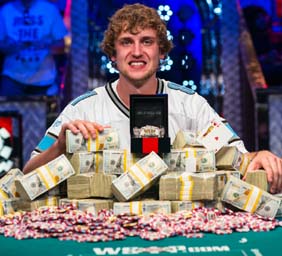
The winner of the $10,000 buy-in WSOP Main Event Championship was Ryan Riess, originally
from Waterford, MI (USA). He now lives in Las Vegas.
Riess is a 23-year-old professional poker player. He has been playing since he was 14 years old.
The play in today's poker tournaments is significantly different than it was just a few years ago. Loose aggressive play is far more common, as are smaller sized raises, and raises and reraises with weaker hand values. Many factors have led to this new style,...
The high-stakes action of the World Series of Poker returns to the Mid-South when Harrah's Tunica hosts its WSOP Circuit Event January 23 through February 3, 2014. One of the Circuit's flagship stops, over $35 million in prize money has been...
New Player $1,500 freeroll.
Where: Party Poker
When:14:00 ET,Every Saturday
To be eligible you must have made your first deposit within the 60 days prior to the start of the tournament.
World Poker Tour® is expanding its already substantial Season XII schedule with the addition of the exciting new WPT® Fallsview Poker Classic in February 2014. Following on the success of its recent events in Montreal, WPT is giving Canadian players another opportunity to compete for the chance to have their name etched onto the prestigious WPT Champions Cup...
The $2,700 No Limit Hold'em Main Event at the 2013 Foxwoods World Poker Finals had 302 entrants start play on Friday
and Saturday battling it out for a piece of the $732,350 prize
pool. Fifty six returned at noon on Sunday for day three action. Play continued for just over four hours before the money was
reached, and another five hours before play was over for the
night with twelve players remaining.
Heartland Poker Tour completed 2013 with their 20th stop of Season IX, making it a record year for the televised poker tour. The recent stop in Gary, Indiana also pushed HPT past the $50 million mark in prize money awarded to date. Over $152k of it went to the latest champ, Edward Ochana...
With all the operators that cater to Brits nowadays, it may be hard to find the best one to play at. As we have learned on www.bestcasinosites.net, each and every one of the more renowned casino sites have something special to offer players, whether it is a generous welcome bonus, a really wide range of games and many extravagant variations, a really good mobile app or sometimes all of the above. You just need to find the right one for you.